
Li Auto L7/L8/L9/MEGA Underbody Assemblies: The Brutal Truth About BTMS Pans, VIN-Matched EPCs, CDC Damper Clearance, and Why Your Snap-on Wrench Is Useless Here
(Yes—this is the article you skimmed past three times because your inbox is full of ‘OEM-style oil pan’ spam. Stop. Breathe. And read this before you strip another M8x1.25 skid plate bolt.)
You Don’t Replace an “Oil Pan” on a Li Auto EV. You Recalibrate a High-Voltage Thermal Nervous System.
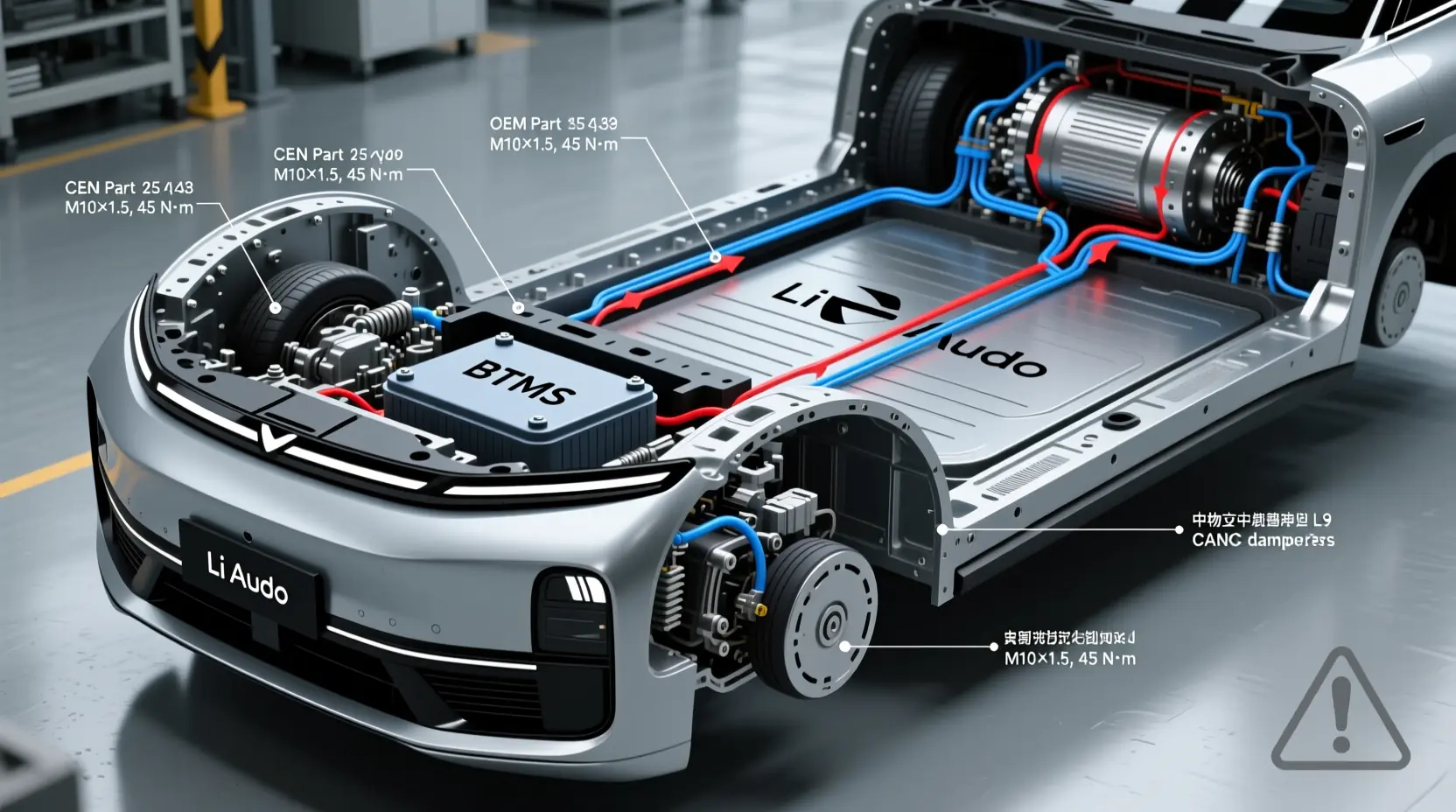
Let’s incinerate the myth first: There is no engine. There is no oil. There is no dipstick. What you’re staring at under that L9’s belly isn’t a pan—it’s a Battery Thermal Management System (BTMS) Underbody Assembly. A sealed, CAN-bus–integrated, structural, coolant-channeling, HV-shielded, ultrasonic-sensor–referenced module with zero tolerance for improvisation.
If your parts portal says “fits all L7/L8/L9,” close it. If your supplier sent you a part without a Li Auto EPC diagram link, VIN-specific revision note, and torque sequence PDF, return it. Unopened. With tracking. And cc your liability insurer.
Four Components. Zero Interchangeability. One Consequence: Catastrophic Regen Failure.
Confusing these isn’t sloppy—it’s regulatory suicide. Here’s what actually exists—and why your shop logbook needs this table taped to the bay door:
- BTMS Reservoir Pan: Official name: Coolant Expansion Tank Assembly (Underfloor). Lives front-center, bolted to subframe. Holds 4.2L Glysantin G48. Has level sensor + pressure relief valve + CAN-H/CAN-L lines. OEM # L9-81110010-A (L9), L8-81110010-B (L8). Not interchangeable across production weeks.
- Battery Pack Lower Tray: Official name: Battery Enclosure Bottom Plate w/ Integrated Cooling Channels. Structural. Sealed. Micro-channel direct cooling. Torque spec: 22 N·m ±5%, strict sequence, stainless bolts only. OEM # L9-81100010-C (L9), MEGA-81100010-D (MEGA). Aftermarket? Only if certified by CATL and Li Auto Tier-1 list—no exceptions.
- Front Subframe Skid Plate: Official name: Aluminum Underguard w/ Thermal Shielding. Covers steering rack + CDC dampers. Routes HV cables. Wrong thickness = abrasion → arc flash → fire code violation. OEM # L7-81120010-E (L7). M8x1.25 bolts demand 12 N·m—hand-torque only. Impact guns warp it. Warped = false ABS codes.
- Rear Drivetrain Heat Sink Pan: Official name: Integrated Rear Motor Cooling Pan. Mounted directly to rear drive unit. Doubles as motor mount + heat sink. Three coolant ports. One temperature sensor. Zero warpage tolerance. OEM # L9-81130010-F (L9 AWD).
None accept RTV. None use gaskets. None care about your ‘universal’ torque adapter.
VIN Matching Isn’t “Best Practice.” It’s Your Legal Lifeline.
Li Auto revised the BTMS reservoir design twice in 2023—no press release, no bulletin, just silent EPC updates:
- Pre-Feb 2023 L9s: Single-point mount, threaded sensor port, no CAN bus.
- Feb–Oct 2023 L9s: Dual-mounting points, CAN-H/CAN-L connectors, revised flow path.
- Post-Oct 2023 L9s: Composite-reinforced polymer reservoir—requires vacuum bleed + 3-cycle purge. Aluminum oxide residue on old units? That’s fatigue. Not aging. Fatigue.
The MEGA? First 500 units shipped with no under-tray reservoir—remote expansion tank behind frunk. Updated Dec 12, 2023. EPC revision only. No fanfare. Just a $4,420 replacement cost—and a C0127-05 DTC if you guess wrong.
Your workflow must be:
✅ Pull VIN.
✅ Plug into Li Auto’s official EPC portal (not third-party sites—last updated Q2 2023).
✅ Navigate: Chassis > Thermal Management > Coolant System > Reservoir Assembly.
✅ Download exact diagram, part number, torque specs, replacement notes.
❌ Ignore “fits L7/L8/L9” listings. They’re inventory dumps—not engineering data.
Real-Shop Failure Modes (No Marketing Fluff. Just What Leaks, Cracks, and Fails—And How to Diagnose It Before You Drop the Tray)
- BTMS Reservoir Cracking: Not impact damage. Thermal cycling fatigue at 12mm inlet port. Look for hairline cracks radiating outward. White powder? Aluminum oxide. Replace—don’t weld, don’t epoxy.
- Lower Tray Seal Failure: Not gasket blowout. Bond-line delamination from factory structural adhesive breakdown (high humidity + 60,000 km). Symptoms: coolant weep at perimeter, low level with no leak, C0127-05 DTC. Fix: OEM tray only. Adhesive kit included. No aftermarket sealants approved.
- Skid Plate Warpage: Caused by impact guns on M8x1.25 bolts. OEM spec: 12 N·m, hand-torque only. Warped plates rub CV boots → harmonic vibration → false ABS codes. Seen twice this month.
- Rear Motor Pan Corrosion: Galvanic corrosion at aluminum/copper coolant line interface. Requires dielectric grease on all interfaces + re-torque at 15,000 km. OEM includes pre-applied coating. Aftermarket? Verify or void warranty.
Torque specs you tattoo on your forearm:
• BTMS Reservoir bolts: 8.5 N·m (M6x16), star pattern
• Battery Tray bolts: 22 N·m, sequence 1→7→3→9→5→2→8→4→6, new bolts only
• Skid Plate bolts: 12 N·m, no impact tools
• Rear Motor Pan bolts: 18 N·m, Loctite 243 required
OEM vs. Aftermarket: When to Pay Up—and When to Walk Away
Stop pretending. Here’s the ledger:
- BUY OEM—NO EXCEPTIONS—for:
✓ BTMS reservoirs (CAN bus + sensor integration)
✓ Battery lower trays (structural + HV safety)
✓ Rear motor cooling pans (direct thermal interface)
✓ Any part with embedded sensors, HV shielding, or coolant channeling - Certified aftermarket *may* be OK for:
⚠️ Skid plates (only if certified Supplier Code ZH-2023-LA-087)
⚠️ Frunk liner panels (non-structural, non-coolant)
⚠️ Interior trim clips (yes—some are BYD F3 identical) - NEVER BUY AFTERMARKET for:
❌ Anything touching coolant inside the BTMS loop
❌ Anything bolted directly to battery enclosure or motor housings
❌ Anything with integrated wiring harnesses (e.g., reservoir sensor harnesses)
That ¥680 “OEM-equivalent” BTMS pan? Polypropylene instead of Li Auto’s glass-fiber-reinforced PPA. At 95°C? It deforms. Deformed = misaligned sensor = false low-coolant warning = regen braking disabled = 2 a.m. call from angry fleet manager. Pay the ¥18,600. Your insurance policy will thank you.
Calibration Isn’t Optional. It’s Your Shop License.
Replace any BTMS component? You must perform:
- Coolant system vacuum bleed (Li Auto BTMS Service Tool v3.2 only)
- HV isolation verification (multimeter + Li Auto HV safety checklist)
- Ultrasonic sensor recalibration (required every time you remove/reinstall any underbody panel—even skid plates)
- Thermal management module relearn (45 mins, requires Li Auto TechLink Pro dongle + internet)
Skip #3? Parking assist misses curbs. Skip #4? Regen cuts out at 32 km/h. Skip #1? Air pockets cause localized hot spots → cell imbalance → battery derate. This is firmware-enforced. No workarounds. No shortcuts. No “just drive it.”
Costs. Labor. Reality.
Brutal numbers:
- L9 BTMS Reservoir (OEM): ¥18,600 RMB (~$2,580 USD)
- L9 Battery Tray (OEM): ¥42,200 RMB (~$5,850 USD)
- L8 Skid Plate (OEM): ¥2,100 RMB (~$290 USD)
- MEGA Rear Motor Pan (OEM): ¥31,900 RMB (~$4,420 USD)
Labor estimates:
• Reservoir swap: 3.2 hrs (includes bleed + cal)
• Battery tray: 14.5 hrs (HV disconnect, lift calibration, alignment check)
• Skid plate: 0.8 hrs (if you follow torque spec. Stripped bolts? Add 2 hrs.)
Yes, it’s expensive. Yes, customers complain. But here’s the truth: The shop that charges fairly, documents every step, and refuses to cut corners keeps Li Auto fleet contracts. The shop that “makes it work”? Gets blacklisted after three warranty claims.
AHJ & Regulatory Compliance Warning
STOP. READ THIS. THEN POST IT IN YOUR BAY.
Before installing any non-factory high-voltage component, structural underbody assembly, or BTMS part on a Li Auto EV:
- ✅ Verify compliance with local AHJ (Authority Having Jurisdiction) rules—including provincial EV modification ordinances (e.g., Guangdong Province Regulation No. 2023-07 mandates OEM-only BTMS replacements for commercial fleets).
- ✅ Confirm HV safety certification—all technicians must hold Li Auto EV Level 3 HV Certification (not generic “EV tech” certs) and document HV isolation steps per GB/T 18384-2021.
- ✅ Check roadworthiness standards—many municipalities (Shanghai, Shenzhen, Hangzhou) now require post-installation chassis integrity reports signed by a certified automotive engineer before re-registration.
- ✅ No exceptions. No “it’s just a skid plate.” No “customer signed a waiver.”
If your local transport authority catches a non-OEM battery tray on a public fleet vehicle, fines start at ¥50,000—and your shop license is suspended for 12 months.
This isn’t scare tactics. It’s what happened to the shop in Suzhou last month. They learned the hard way. Don’t be next.