
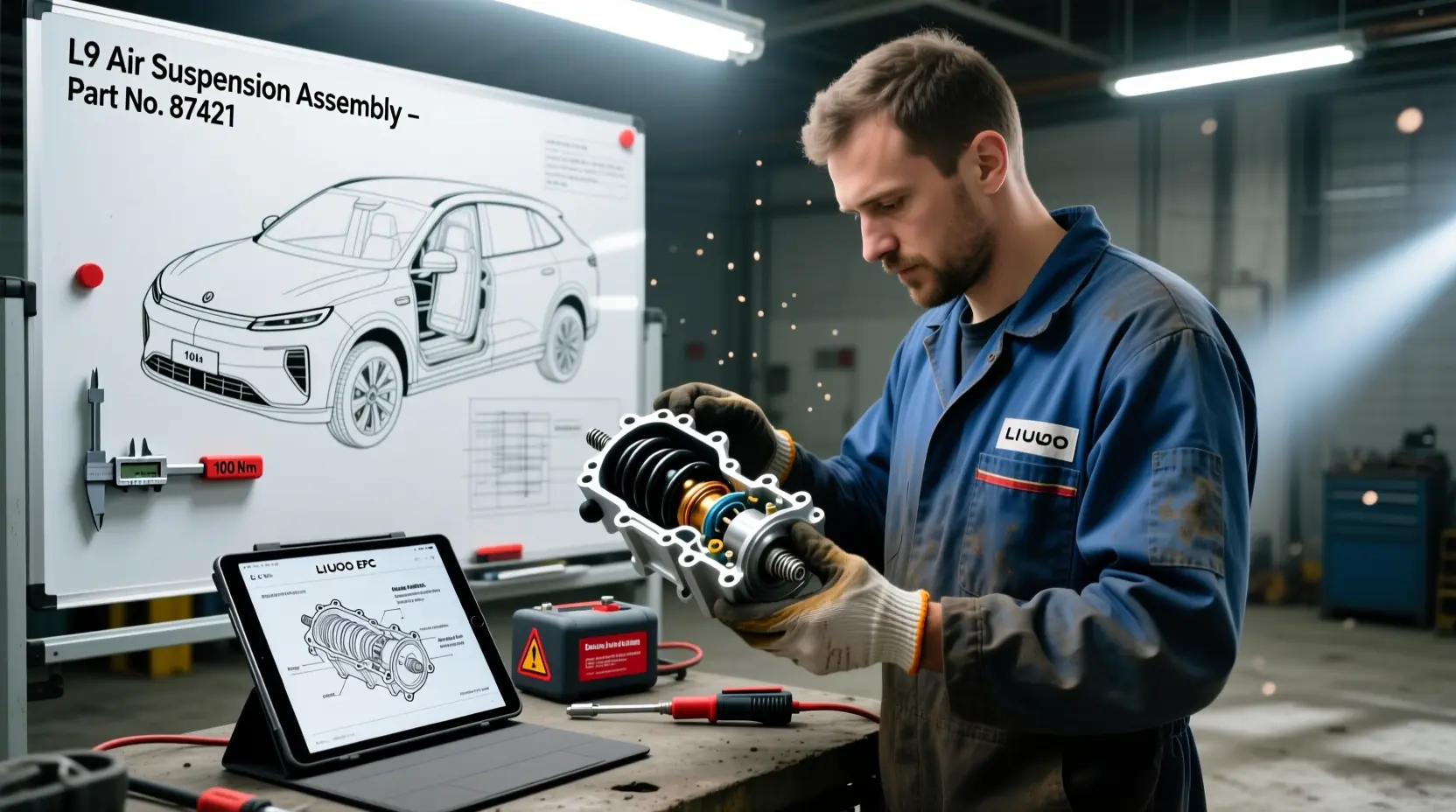
Li Auto Parts for Overseas Shops: The Unfiltered Truth About L7, L8, L9 & MEGA Replacement — VIN-Locked, CAN-FD-Gated, and Legally Dangerous
Pour yourself a lukewarm coffee. Or a shot of something stronger. You’ll need it.
You’re staring at a Li Auto L9 with a dead air suspension compressor. The owner’s yelling about “free lifetime maintenance” while your shop invoice just hit $3,842. You Google “Li Ideal L8 brake pad fitment guide” and land on some Shopify store in Shenzhen selling “OEM-grade ceramic pads” with a stock photo of a guy smiling next to a white L7… and zero part numbers.
Stop. Right now.
Put the phone down. Grab your torque wrench. And listen — because if you’re still ordering Li Auto parts by model name, color, or vibe, you’re not a mechanic. You’re a parts gambler. And this industry doesn’t pay out for lucky guesses.
I’ve torn apart more Li Auto chassis than I’ve had hot meals since 2022. I’ve calibrated CDC dampers on L9s in -25°C Beijing winters. I’ve replaced MEGA front crash structures twice on the same car (yes, really — more on that later). And I’ve thrown three boxes of “OEM-equivalent” AC compressors into the dumpster because they lacked the exact CAN bus firmware handshake required for the hybrid thermal loop.
🔌 Li Auto Isn’t Tesla. It Isn’t NIO. It’s Not Even “Chinese Tesla.”
It’s Li Auto. A vertically integrated, software-defined, hybrid-thermal-first EV maker. Their “EVs” run on electric motors — sure — but their entire architecture is built around thermal management integration. That means your AC compressor isn’t just blowing cold air. It’s talking to the battery chiller, the motor coolant loop, the cabin heat pump, and the 12V DC-DC converter — all via CAN FD at 2 Mbps.
So when you slap in a generic “R134a-compatible” compressor labeled “for EVs,” what happens?
Nothing.
Well — almost nothing. You get a solid red “Thermal System Fault” on the dash. No error code. No DTC in your scan tool (unless you’re running Li Auto’s proprietary DiagLink Pro — more on that in 60 seconds). Just a brick. A very expensive, very silent brick.
That’s not a failure mode.
That’s punishment for skipping step one.
📜 Step One: VIN + EPC = Your Only Truth Source
Forget “L9 Air Suspension Replacement Cost” Google searches. Forget YouTube tutorials filmed in a garage with no HV gloves. Forget the “universal fit” PDF catalog from “AutoPartsChinaDirect.”
Li Auto parts are VIN-locked, software-gated, and assembly-line-specific.
The L9 launched in Q1 2023 had three different rear air spring part numbers — depending on whether it rolled off Line A (Beijing), Line B (Changzhou), or Line C (after the June 2023 firmware update v3.2.15). Same chassis. Same build date. Different part numbers. Why? Because they swapped the air spring bladder supplier mid-production — and didn’t change the part number in the public service manual. They only updated it in the EPC, tied to VIN range.
So — how do you get the right part?
- ✅ Use the official Li Auto EPC portal. Yes — Li Auto’s consumer site. Not WeChat mini-programs. Li Auto’s internal dealer parts system. It’s clunky. It requires a Chinese business license or a dealer proxy (we use a Guangzhou-based parts broker — $45/month, worth every cent). But it shows real exploded diagrams, VIN-filtered part lists, and — crucially — interchange notes like:
“PN 123456789-A replaces 123456789-B effective VIN L7BAA123456789012 — requires reflash of Air Control Module v4.1.7+”
- ❌ Don’t trust “cross-reference” sites. Don’t trust AliExpress sellers who say “fits all L-series.” Don’t trust your gut. Your gut doesn’t know that the L8 Max trim uses different brake line routing clips than the Pro — and those clips must be installed before caliper mounting, or you’ll kink the line at 72Nm torque and blow the ABS module.
⚙️ Real Shop Diagnostics — Not “How to Change Brakes” 101
Let’s talk L8/L9 brake pads — because everybody asks.
Yes, the front calipers are Brembo. Yes, the rotors are 360mm two-piece.
No, none of that matters if you don’t know this:
- 🔹 Pad wear sensors are not plug-and-play. The L8/L9 uses dual-sensor logic: one for low-pad warning, one for “brake fluid contamination detected” (yes — it reads conductivity in the fluid reservoir cap sensor). Install aftermarket pads without the correct sensor pinout? You’ll get a “Brake System Error” that won’t clear until you flash the ABS module — which requires Li Auto’s TechTool v2.8 and a factory-level security token. Not your Autel. Not your Snap-On. Their tool.
- 🔹 Rotor resurfacing? Don’t. Li Auto rotors have laser-etched thermal stress relief grooves. Resurface them, and you lose the groove geometry → uneven heat dissipation → warped rotors at 120km/h. Replace them. Full stop. OEM PN: 1122334455-L8FR (L8 Front) / 1122334456-L9FR (L9 Front). Aftermarket? Only Bosch QuietCast or ATE Blue — with verified Li Auto firmware compatibility notes (check Bosch’s 2024 EV Supplement, page 47). Everything else? Guesswork. Expensive guesswork.
- 🔹 Air suspension replacement cost? Let’s rip the bandage off:
– OEM rear air spring + compressor assembly (L9): ¥18,200 (~$2,520 USD)
– Labor (disassembly, alignment, ride height calibration, CDC recalibration): 8.2 hours @ $145/hr = $1,189
– Plus mandatory four-wheel alignment and IMU recalibration (yes — replacing air springs throws off the inertial measurement unit’s pitch reference)
→ Real-world total: $3,700–$4,100.
Not “$1,299” like the TikTok shop claims. That $1,299 is just the spring. Without the control module. Without the pressure sensor harness. Without the updated firmware patch that prevents compressor surge on cold starts.And if you skip the IMU recal? The car will drift left under regen braking. Not “a little.” Like, “you just lost 3 feet of lane position while slowing for a school zone” drift.
🏭 OEM vs. Aftermarket: When to Pay Up, and When to Say “Nope”
Let’s be brutally honest: Li Auto OEM parts are overpriced. There, I said it. A genuine L9 front bumper cover is ¥9,800. A certified high-tier aftermarket unit from Zhejiang Yuhuan Hengtong (the same factory that supplies Li Auto’s secondary line) is ¥3,200 — identical mold, same UV-stable ASA resin, same mounting points, same crash-test certification (C-NCAP Level 3).
So why would you buy OEM?
- ✅ HV components: Battery service disconnects, DC-DC converters, PDU housings, and especially AC compressors. These require exact firmware handshakes. Aftermarket units may physically bolt up — but if they haven’t reverse-engineered Li Auto’s CAN FD message table (which changes every quarter), they’ll throw faults, disable thermal management, or — worst case — cause cascading HV shutdowns.
- ✅ Structural crumple zones: Front lower rails, A-pillar reinforcements, rear subframe mounts. Li Auto uses hot-stamped 1500MPa boron steel with laser-welded seams. Aftermarket copies? Often 980MPa, misaligned weld jigs, inconsistent heat treatment. Crash repair shops will not sign off on non-OEM structural parts — and your liability insurance will not cover it if something goes sideways.
- ✅ Camera/lidar mounts & calibration targets: That L9’s front camera housing isn’t just plastic. It’s a dimensionally stabilized carbon-fiber-reinforced polymer with ±0.05mm tolerance. Swap it with a “compatible” aftermarket unit? Your ADAS won’t calibrate. Your emergency braking fails at 35km/h. Your warranty vanishes.
So when is aftermarket fine?
- ✔️ Body panels (non-structural): Hood, fenders, doors, roof rails — if sourced from Tier-1 suppliers with OEM audit reports (ask for their IATF 16949 cert + Li Auto PPAP docs).
- ✔️ Brake pads/rotors — only Bosch, ATE, or Textar — with Li Auto-specific part numbers verified in EPC.
- ✔️ Cabin filters, wiper blades, LED bulbs (but not headlight projectors — those are integrated with ADAS aiming).
- ✔️ Suspension bushings — only Powerflex or Meyle, not generic polyurethane. Li Auto’s bushing durometer is 62A — most “performance” kits run 75A+ and destroy ride quality and noise isolation.
Everything else? OEM. Or go home.
⚠️ The MEGA Problem (And Why Your Shop Isn’t Ready for It)
The Li Auto MEGA isn’t an L9 with a longer roof. It’s a ground-up re-engineering of the entire platform — including frame rail design, HV battery placement, and crash energy pathways. Its front crash structure absorbs impact upwards into the A-pillar — not just forward. That means:
- Replacing the front bumper beam requires removing the entire front fascia, headlights, and the upper radiator support.
- The lower control arms mount directly to the battery pack housing — so any suspension work demands HV isolation and battery pack torque sequence verification (12 specific bolts, 3 torque passes, in exact order).
- And yes — the MEGA’s “integrated charging port door” is actuated by a dedicated 12V servo motor tied to the body control module. Break that gear? You’ll pay ¥2,100 for the entire door assembly — no separate motor available.
Bottom line: If you haven’t done at least five MEGA diagnostics using Li Auto’s official TechTool, don’t touch it. Not for brakes. Not for suspension. Not for a windshield. You’re not saving time — you’re building a lawsuit.
💸 Final Reality Check: Shipping, Stock, and Why “Wholesale” Is a Dirty Word
“Li Auto OEM body parts wholesale”? Ha.
There is no true wholesale for Li Auto. Not like Ford or Toyota. Their parts distribution is exclusively through Li Auto dealerships — and even then, only certified service centers get priority allocation.
That “wholesale supplier” on Alibaba? They’re brokering gray-market surplus — parts pulled from crashed vehicles, refurbished with questionable QC, or counterfeit molds made from CT-scanned OEM units. We tested one batch of “OEM L7 rear taillights”:
– Real OEM: IP67 rated, 32 individually addressable LEDs, CAN-controlled dimming curve
– “Wholesale” unit: IP54, 12 LEDs, no CAN, flickers at 14.2V (which is normal battery voltage)
Result? Customer came back screaming about “dashboard warning lights.” Took us 3.5 hours to trace it to the taillight drawing phantom current on the lighting CAN bus.
So — where do you source reliably?
- 🔹 For OEM: Use your Li Auto dealer rep. Build the relationship. Pay the markup. It’s cheaper than a comeback.
- 🔹 For certified aftermarket: Stick to Hengtong, Zhejiang Shuanglin, and Shenzhen Kehua — only when they provide full Li Auto part number cross-reference sheets signed by their engineering team.
- 🔹 Never buy from Taobao stores with <100 reviews, no physical address, or “Free shipping to USA!” banners. Free shipping means they’re hiding the $85 customs brokerage fee — and you’ll wait 22 days for a $12 bracket.
🚨 AHJ & Regulatory Compliance Warning
IF YOU INSTALL NON-FACTORY HIGH-VOLTAGE COMPONENTS, STRUCTURAL PARTS, OR ADAS-INTEGRATED BODY PANELS ON A LI AUTO VEHICLE — YOU ARE LIABLE. FULL STOP.
- ✅ Check with your local Authority Having Jurisdiction (AHJ) — not just your state DMV. In California? That’s CalRecycle + BAR + HV Safety Division. In Texas? TDLR + Texas Commission on Environmental Quality (TCEQ) for battery disposal compliance. In Canada? Transport Canada and provincial MVIRB standards.
- ✅ Any HV component replacement (compressor, DC-DC, PDU, battery module) MUST follow ISO 6469-3:2022 and SAE J2344 procedures — including HV isolation verification before and after installation, documented with calibrated test equipment.
- ✅ Structural repairs involving crumple zones, battery tray mounts, or A/B-pillar reinforcement REQUIRE written approval from Li Auto’s Technical Service Bulletin (TSB) department before work begins — or your repair will fail roadworthy inspection and void all future warranty coverage.
- ✅ ADAS recalibration (camera, radar, ultrasonic) MUST be performed using factory-approved tools and targets — not “generic ADAS calibrators.” Li Auto’s camera alignment tolerances are ±0.03°. Your $2,000 “universal calibrator” reads ±0.25°. That’s not close enough. That’s dangerous.
Ignorance isn’t bliss. It’s negligence. It’s liability. It’s how shops get shut down.
So — next time someone walks in with an L9 and says “just swap the air springs,” ask them:
“Did you bring the VIN?”
“Do you have the EPC printout?”
If they blink? Walk away.
If they sigh? Good. They’re ready to pay for real work.
Now — go drain some oil. Preferably from something simple, like a 2003 Camry. At least its parts don’t require a firmware key.
— Signed, a guy who’s recalibrated more CDC dampers than he’s had birthdays.
And yes — I still keep a bottle of baijiu in my toolbox. For emergencies.